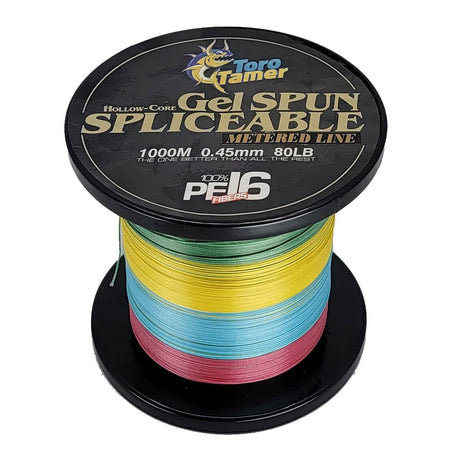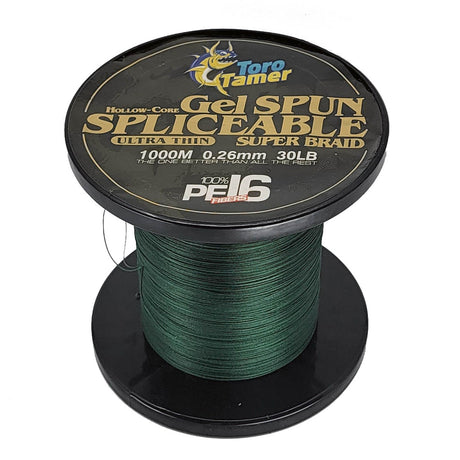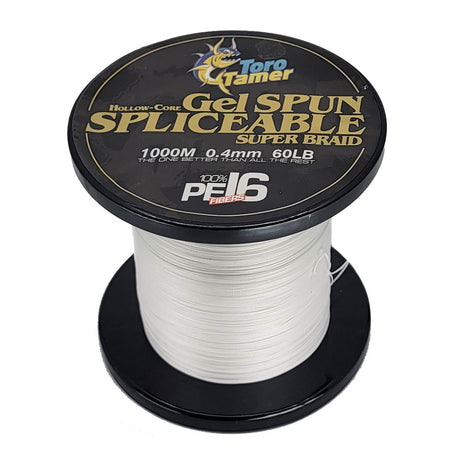

LINE ONE - Background Information
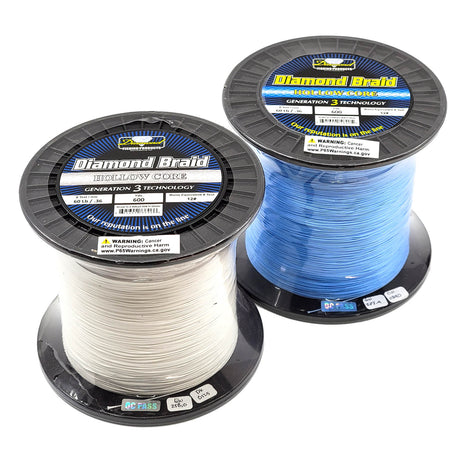
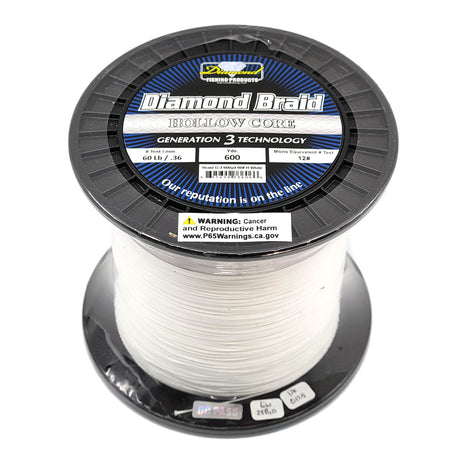
Hollow, Spliceable, Gel Spun Braided Spectraâ
-
words
from Jerry...
The Products: General
Spectra fiber braided fishing lines have
gained wide-spread acceptance in the last few
years because:
- Low Stretch
Spectra has very low-stretch (3% maximum)
which means a fish bite is easily felt and the
hook-set is quick and sure. Getting a fish
away from the bottom structure is more likely,
compared to monofilament stretching more than
25%.
- Small Diameter
A very high strength-to-diameter ratio of
Spectraâ is
attractive because:
- More line can be put on a given reel.
- Smaller reels may be used in a given
application.
- Greater breaking strength line may be
spooled on the same reel.
Line One Spectra line is 40% the diameter
of monofilament and somewhat smaller than
non-hollow Spectra of the same line test.
Table 1 - Diameter in Inches
|
Test Strength |
Line One Spectra |
Monofilament |
| 80 |
0.014 |
0.034 |
| 130 |
0.019 |
0.047 |
| 200 |
0.023 |
0.055 |
Many like to compare the size of spectra to
that of monofilament.
For example 80# spectra is the size of 25#
Mono.
Table 2 - Equivalent Diameters for Various
Line Tests
| Type |
Breaking Test Strength |
| Spectra |
12 |
20 |
30 |
50 |
60 |
80 |
130 |
| Monofilament |
4 |
6 |
10 |
14 |
20 |
25 |
40 |
High Tensile Strength
Spectra fiber is so strong that it is used in
bulletproof vests; replacing Kevlar in that
application. It is about 10 times as strong as
steel, pound for pound. The finished line has a
tensile strength of about 600,000 pounds per
square inch versus monofilament which has a
tensile strength of about 100,000 pounds per
square inch.
Long Life
Spectra has a very long life, it does not
rot, and is not readily damaged by ultraviolet
rays in sunlight, as is monofilament.
Not Effected by Water
Spectra does not swell in water, nor does it
lose strength when wet.
Light Weight
Line One does not weigh you down.
Stand-up fishermen really appreciate the
lightweight of a spool of Line One.
Table 3 - Yards per Pound of Line
|
Test Strength |
Line One Spectra |
Monofilament |
| 80 |
2500 |
700 |
| 130 |
1750 |
350 |
| 200 |
1200 |
240 |
Put another way, filling a Penn 30 with 700
yards of 80# Line One Spectra adds only
4.5 ounces to that 56 ounce reel.
830 yards of 130# Line One on a Penn
50SW adds only 8 ounces to that 68 ounce reel.
This is important to stand up fishermen.
LINE ONE: Better than all the Rest
To overcome some of the drawbacks to an
otherwise good line, Jerry Brown, an avid
fisherman, convinced one line manufacturer to
braid Line One Spectra fibers as a hollow
tube but also with a much tighter smoother
texture using smaller diameter fibers. Some have
described the difference between Line One
Spectra and competitive non-hollow Spectra lines
as comparing silk to burlap.
All Spectra lines are opaque and may be
visible to some fish, therefore most
knowledgeable fishermen want to present a
less-visible monofilament or fluoro-carbon
leader attached to the hook. First generation
non-hollow Spectra fiber lines made the
connection between braided line and monofilament
leaders difficult. Knots, like the Albright, are
bulky, hard to tie correctly, and not ever 100%
strong. The unique hollow Spectra lines
described here, overcomes that problem and offer
additional advantages.
Why hollow? A hollow line allows you to
insert a length of monofilament inside the line
for a distance sufficient to set-up the
opportunity for the "Chinese Finger Cuff" to
take hold to prevent the monofilament from being
pulled out. This provides the "knotless" splice
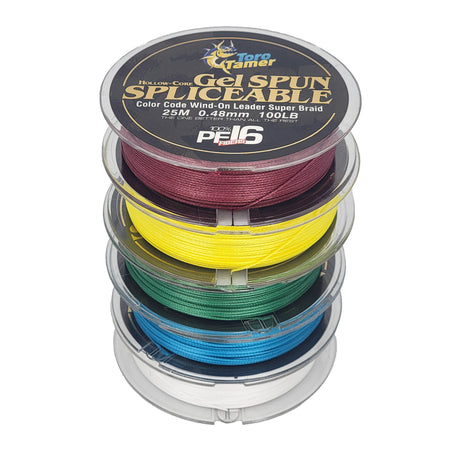
between Line One and your mono.
SPECTRA to SPECTRA : The Invisible Knotless
Splice
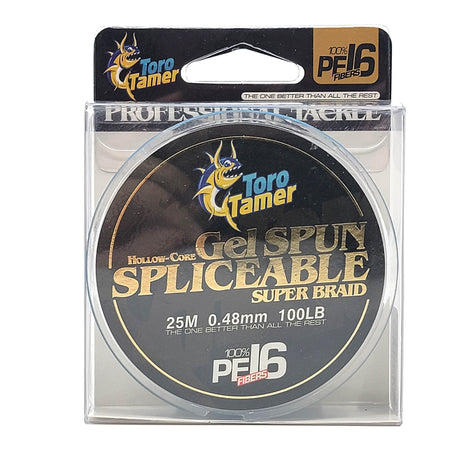
One length of hollow Spectra can be spliced
to another. This need comes up when you want to
add more line to the reel or to replace a
section of line that has been damaged. Imagine
that you are fishing and have a lot of line out,
you get in a tangle and a crew member says he
has to cut your line to save another fisherman’s
fish. No problem. After the cut, you can splice
the line back together. This splice, which is
not a knot, passes almost undetected through all
rod guides. It is easy to make and it is 100%
strong. You can’t do that with conventional
non-hollow Spectra lines nor with monofilament.
Example: You can even splice one breaking
strength line to another of different breaking:
80# hollow to 130#; 130# hollow to 200#. This is
advantageous when you want a larger mono leader
that could not fit inside the smaller hollow
line. These splices are accomplished with a
small latch needle, a loop needle, or even a
doubled length of single strand wire—say 30#
test.
END LOOPS
End-loops in hollow braided Line One
are possible without knots such as the Bimini
Twist. End loops can easily be spliced into the
line on the reel so that the popular
loop-to-loop portable top shot connections can
be used. A similar end loop on pre-made leaders
fabricated with hollow Line One makes
change of leaders quick and easy as fishing
conditions dictate. More importantly,
leaders can be changed quickly as fishing
conditions dictate. Some commercially available
top shot leaders are formed with bulky Dacron so
that they pass through regular sized guides and
roller guides only with great difficulty. Top
shot leaders made with hollow Line One,
provide small almost undetectable connections
and readily pass through guides without
difficulty. The better top-shots are made this
way ---INSIST ON THIS QUALITY.
A spliced end loop is useful if you want to
connect hollow Line One directly to a
hook as halibut fishermen do, or to a swivel
connecting to a monofilament leader, common in
chunking for tuna, or to a swivel connected to a
gangion for rock cod fishing. The off-shore
swivel knot works well.
FINE TEXTURE of LINE ONE
Line One is fabricated with ultra-fine
fibers; this results in a line which is easier
on the hands and equipment. Compare this Line
One side-by-side with the other braided
Spectra lines and the difference is obvious. For
example, the 80# hollow Line One has
individual fibers which are ½ the size of
competitive lines and there are twice the
number.
Not only are the individual fibers smaller in
diameter, but they are grouped for braiding into
twice as many bundles. Next, when they are
braided, there is almost 50% more braids per
inch. Instead of a round solid braid, they are
braided into a continuous hollow tube. The
result is Line One with a smoother, silky
feel.
Early speculation that braided lines would
cut or groove rod guides has been proven to be
totally unfounded and without merit. Since a
hollow braid with Line One can flatten as
it flows over any surface, there is even less
chance of erosion compared with a round, hard
braid of competitive Spectra lines.
Long Life and Fewer Replacements
Spectra lines have a greater life expectancy
than monofilament. Resistance to UV in sunlight
is one reason but when you damage monofilament
or even ordinary non-hollow Spectra lines, you
will likely decide to replace the entire spool
in order to maintain integrity and to keep
enough line on the reel to handle that big one.
With Line One, you need not replace the
entire spool. Simply cut out the damaged section
and splice in a new section or splice the two
ends of good line together. These splices are
made easily and quickly with very inexpensive
latch needles. This can only be done with hollow
line, and naturally you can’t make knotless
connections with mono-filament. This feature
alone makes Line One hollow Spectra head
and shoulders above other non-hollow Spectra
lines.
The nature of the braid of Line One is
such that when a connection, splice, or loop is
needed, a tool or mono leader may be passed
through the tubular sidewall without damage.
After the splice is made and the tool removed,
the original shape of the hollow Spectra is
re-established.
RESISTANT to NICKS
Since LINE ONE is made of many, many
individual long fibers, a nick will likely
compromise only a few fibers leaving the
remaining individual fibers un-compromised.
Whereas a nick in monofilament can propagate
right across the line leading to complete
failure – much like a small crack in your car
windshield can quickly spread across the entire
piece of glass. No such problem with Line
One.
MUCH BETTER BAIT ACTION
Live bait fishermen love Line One !!
Many use the small diameter, light weight hollow
line as their main line and then connect a
relatively short section of mono-filament or
fluorocarbon leader. During the cast, the line
and the spliced-on leader pass easily through
the guides unimpeded; the instant the bait hits
the water, you will notice the difference. Due
to the decreased line diameter and resulting
lower drag in the water, the line is easily
pulled by the bait making it effectively more
lively. Since the line does not stretch very
much (only 3%), you feel every tail beat, and
you will know where your bait is and how lively
it is. Since the line is smaller than
monofilament, when the bait turns, there is less
belly in the line; this also helps you avoid
tangles.
FISHING DEEP WATER
When the fish are deep, the smaller line is
much less effected by current or by the moving
boat than the much larger monofilament. When
weights are used to get bait or lures deep,
markedly smaller weights are needed, so fishing
is physical and more enjoyable.
It is not surprising that some fishermen
capitalize on the lines’ small diameter, not as
an opportunity to add more line to the reel, but
as opportunity to put on higher breaking
strength Line One without reducing the
yards of line on the reel. For example,
replacing 50 pound mono with 80 pound Line
One – and still have more yards on the reel.
FISHING the KITE
When fishing with a kite, the lightweight
Line One has distinct advantage. In low wind
conditions, the kite may be dragged down by the
weight of heavier mono-filament, but not with
Line One. The low stretch makes for positive
hook sets. Bear in mind that when there is a lot
of slack line, combined with the lines’ little
stretch, drags should not be pushed all the way
to strike until the fish has straightened the
line. This reduces the chances of breaking off
or pulling the hook. This is especially
important in Kite fishing.
The Hi Viz Gold Line One is
recommended for the line from the kite reel to
the kite because it is easier to see the release
clip and quickly detect when the fisherman’s
line has been by a strike. Likewise, Hi Viz Gold
is recommended for the Spectra portion of
loop-to-loop Spectra-mono leader. Ten feet of
the high visibility of Gold Spectra makes
ribbons or balloons unnecessary to detect
strikes or bait action; 10-13 feet of
monofilament is sufficient to fool the fish in
this set-up.
SPOOLING UP
The best knots for attaching Spectra to the
reel spool are those knots similar to the San
Diego Knot with several modifications:
- Run the line twice around the spool arbor
instead of once.
- Wrap the standing line with 12 wraps
instead of 5 or 6.
- Carefully pull the knot tight avoiding any
bunching.
- Avoid rapid cinching of the knot. Heat
generated could damage the line.
As a rule of thumb, you can put about 2 ½
times as much Line One on your reel
compared to the same breaking strength
monofilament. We suggest that you put the line
on very tightly. The line does not deform and
crinkle up like monofilament and there is much
less pressure put on the side plates compared
with monofilament, which stretches when put on
tightly. Mono attempts to contract and pressure
the side plates.
When spooling on line, keep tension of the
line by putting pressure on the spool , NOT
on the line lest heat build up and damages
the line. Put the line on slowly enough to put
it on smoothly. Large spools of line as shipped,
are not wound on tightly. Rapid spooling-off may
lead to the opportunity for the line to dig in
the spool and cause a problem, including the
possibility of breaking the line.
Exaggerated criss-crossing the line while
filling or reeling in, is not necessary or
recommended. Just be careful to wind it on
tightly. Criss-crossing increases the amount
of void space in the spool, which increases the
chances for the line to slip down in and bind.
If you put the line on loosely you are asking
for big trouble; in this case criss-crossing
may be your only hope, albeit a poor one. Do
it right the first time!
Consider this: When you are reeling in a
fish, you have very little opportunity to do
exaggerated criss-crossing, it is hard enough to
direct the line gradually from side to side to
avoid a build-up of line in one spot. The
exaggerated criss-crossing is a one-time event
during spooling up. (You get less line on a reel
with extensive criss-crossing).
Prior to spooling Line One some
knowledgeable fishermen splice ten or more yards
of monofilament to the hollow Line One
before spooling it onto the reel. While this is
not necessary, this makes the line less likely
to slip on the pool, although rarely
encountered. A little tape on the first wrap may
ease your mind.
REEL CAPACITIES:
The approximate amount of line needed to fill
popular reels with a short top shot. Adjust for
size of larger top shots:
Table 4 - Line One Reel Capacities
(Approximate)
| Reel Brand and Model |
Breaking Test Strength |
|
80# |
130# |
200# |
| Penn 12 |
400 |
---- |
---- |
| Penn 16/20 |
600 |
---- |
---- |
| Penn 30 |
700 |
500 |
---- |
| Penn 30W |
1000 |
700 |
---- |
| Penn 50 |
1000 |
700 |
---- |
| Penn 50W |
1200 |
830 |
|
| Penn 80 |
----- |
1700 |
1200 |
| Shimano TLD 20
II |
600 |
----- |
----- |
| Shimano TLD 30
II |
700 |
500 |
----- |
| Shimano TLD 50 |
1000 |
800 |
600 |
| Tiagra 50W |
1300 |
1000 |
700 |
| Tiagra 50/S |
1000 |
800 |
600 |
| Accurate 6 |
400 |
----- |
----- |
| Accurate 12 |
400 |
----- |
----- |
| Accurate 30 |
600 |
----- |
----- |
| Accurate 50 |
800 |
600 |
----- |
| Accurate 50W |
1100 |
800 |
600 |
|
*Capacities based on short top-shot (30 feet
Mono) Spectra put on very tightly with no
exaggerated criss-crossing. The amount
varies with technique and how full you fill
the reel. |
Spectra to Mono Top Shots
The Direct Approach.
Practice varies on how much monofilament to
use as a top shot. Many splice only 25 feet of
mono directly onto the hollow Line One.
Others use 100 or 200 yards of mono. However,
this larger amount of mono reduces the amount of
braided line and the large amount of mono
increases the drag on the bait and thus takes
away one of the most important advantages of
using this set-up.
The Portable Top-Shot.
Many more fishermen put a spiced end-loop in
the hollow Spectra* and use a 25-foot wind-on
top shot leader connecting the two,
loop-to-loop. Since the loop-to-loop connection
can be taken apart, quick changes can be made
right at the rail, using pre-prepared leaders.
The Invisible Splice.
A recent innovation is to pre-prepare a
leader with say 10 feet of hollow Line One
into which mono has been inserted 5 feet. When
time comes to change the leader, the leader is
spliced line-to-line to the line of the reel
rather than using a loop-to-loop connection. The
line-to-line connection is 100% and is almost
unnoticeable.
Unexpected Advantages of Spectra Line One.
Fishermen who have grown up fishing
monofilament have experienced the frustration of
the relatively stiff monofilament line springing
off the reel after tossing out a relatively
heavy live bait. The resulting loose
monofilament must then be stripped off the reel
lest a sudden strike causes all kinds of havoc.
This does not occur with Spectra Line One.
The line is limp and light weight and does
not have a tendency to spring-off. Fishing is
then more fun!
Because Line One is small in diameter,
a lot of line may be taken off by a fast running
fish before the spool diameter is reduced enough
to dictate reducing the drag setting—something
we often forget to do in the heat of battle.
Like wise, the drag generated by the line
running through the water is much less with
Line One Spectra than an equivalent length
of mono-filament. This adds a bit of safety
factor when you have a lot of line out.
Oh, don’t forget about benefit of having 2 ½
times as much line on the feel when you might
otherwise face calling for the back-up reel or a
skiff ride.
Standard Sized Spools of Line One
For 80 and 130 test, spools of 33, 100, 300,
600, 1200 and 2500 yards are standard. For 200#
test, the largest spool is 1200 yards. 500#
hollow Spectra is available as a special order.
Line One : Colors
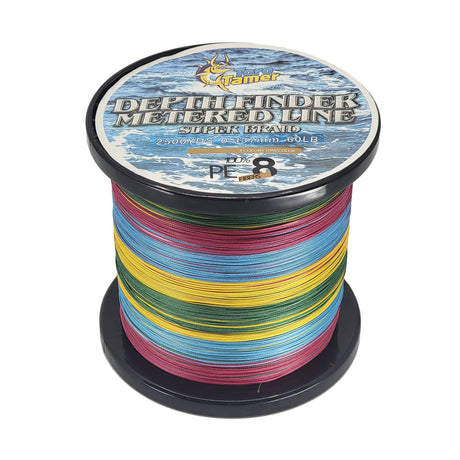
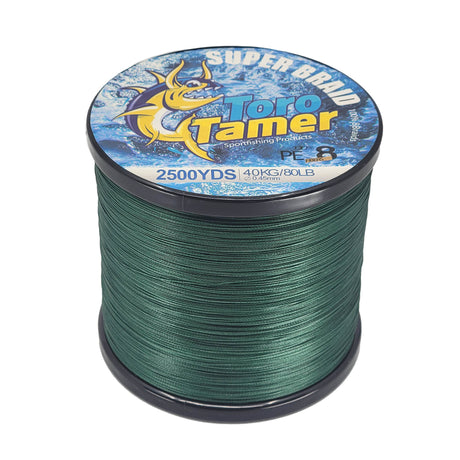
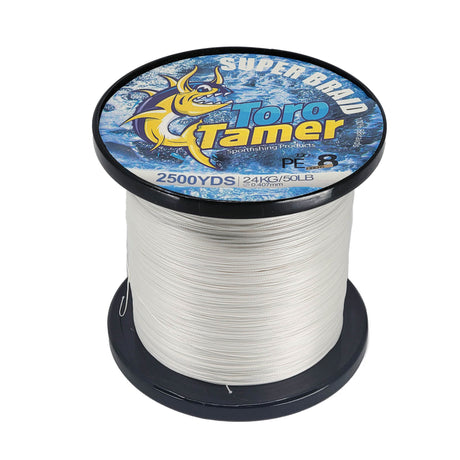
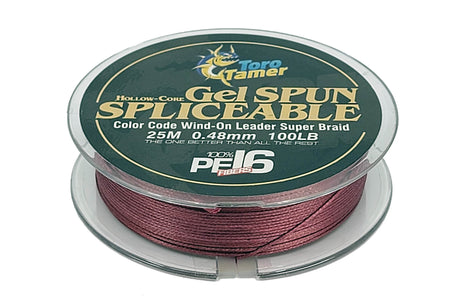
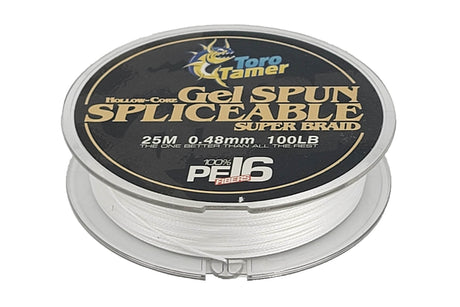
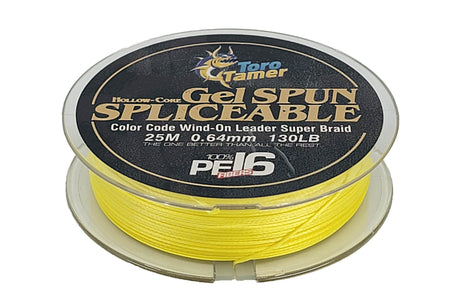
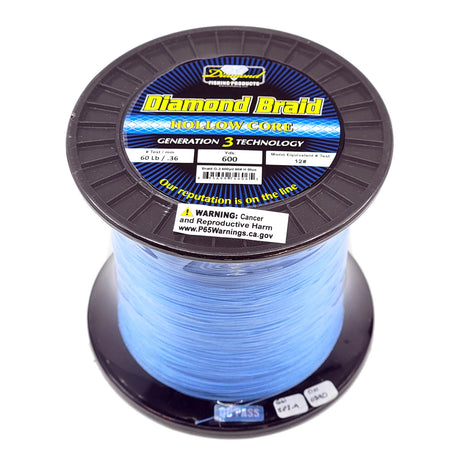
Line One comes in four colors. White
is the most popular, but Green,
Hi-Viz Gold and Platinum colors are
available at the same price.
Line One Hollow Spectra to Monofilament or
Fluorocarbon
With a little practice, inserting
monofilament or fluorocarbon into the hollow
braided line is easy, provided the appropriate
size mono is selected. The closer the diameter
of the monofilament is to the normal inside
diameter of the hollow line, the better the
"Chinese Finger Cuff" forms. Considerable
latitude is workable as the table indicates.
Table 5 - Workable Splice Range
| LINE ONE |
Monofilament |
MAXIMUM DIAMETER |
|
Breaking Strength |
WORKABLE RANGE
(Test Strength) |
Inches |
Millimeters |
|
80 |
20-130 |
0.053 |
1.35 mm |
|
130 |
60-300 |
0.062 |
1.57 mm |
|
200 |
130-600 |
0.098 |
2.49 mm |
Monofilament vs Fluorocarbon
Monofilament brands vary in diameter for the
same specified breaking strength. Most mono
actually breaks at considerably higher levels
than advertised, unless they are IGFA rated.
Fluorocarbon lines usually break very near the
stated strength, with some breaking slightly
below. Manufacturers of nylon monofilament
fishing line can afford to oversize their
product because the basic material is cheap.
Manufacturers of fluorocarbon fishing line have
no such option because the basic material is
much, much more expensive so they must size
their line near the actual labeled breaking
strength. The impression some have, is that
fluorocarbon is not as strong as nylon
monofilament, may come from comparing
monofilament labeled 80# which actually tests
120#, with fluorocarbon labeled 80# which
actually tests 80# or a little less.
Fluorocarbon is less visible to fish than
monofilament.
Drag Setting Precautions
When short lengths of leader material used in
conjunction with braided lines with their very
little stretch, the margin of error is less when
fighting a fish especially at high drag
settings. In situations where a fish is running
with a slack line or with a wide loop in the
line, high shock forces are generated when the
line comes tight and the flex of the rod tip and
the slipping of the drag do not compensate
quickly enough. Drag setting should be reduced
in that situation. Setting the hook is not
always necessary with big game fish when fishing
with low stretch lines and especially not when
using circle hooks. The low stretch of the line
allows the fish to set the hook.
INSERTING MONOFILAMENT into HOLLOW LINE ONE:
Method One: Without Special Tools
Many fishermen are proficient at inserting
mono directly into hollow Line One.
Start by sanding the last ½ inch of the mono
into a smooth, tapered but not sharp, tip, a
bullet shape. It is very important to use very
fine sandpaper, 600 grit is needed for the
finishing.
Open the end of the Spectra by bunching it up
a bit to start, and then insert the end of a
doubled piece of single strand wire (about 30#
wire will do) to open the weave for 3-5 feet. A
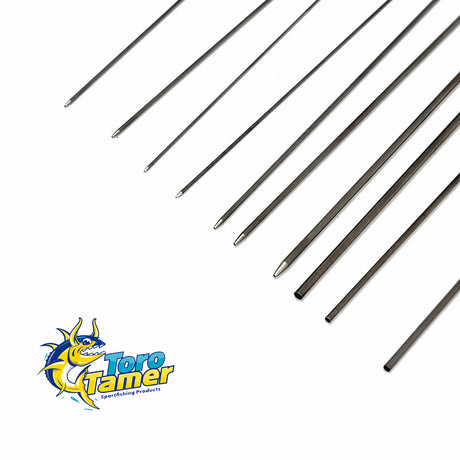
better way is to use a solid stainless steel
needle (about 8" long). These are available from
two sources.
After the braided line is open, slip the mono
into the end. By holding the mono still, you may
then work the braided line onto the mono,
inch-by-inch, until 3-5 feet have been inserted.
NOTE: You put the Spectra onto the mono, not the
reverse. You must stretch out the Spectra on the
mono each time you slip some on. If you don’t,
you won’t be able to complete the operation.
Method Two: Using Special Aids
Inserting mono is greatly facilitated by the
use of 8-inch long stainless steel needles with
a ½ inch hollow portion in one end. These tools
come in various sizes to match the size of
monofilament being inserted. See reference for
sources and tips. Choose a needle about the same
diameter as the mono being used. Next with a
single edge razor blade cut the last ½ inch of
the mono to a fine sharp, thin point. Insert
this pointed mono into the hollow end of the
needle until it jams in tight and will not fall
out. Now, guide the hollow braided line onto the
stationary needle, thence onto the mono for 3-5
feet. The needle can then be removed by pushing
it carefully through the sidewall of the tubular
line, releasing the mono to remain inside.
Forming the "Chinese Finger"
After using one of the two methods above, the
next step is to make sure that the mono does not
slip out before the Chinese Finger Cuff has a
chance to tighten its grip and hold. The
"Chinese Finger Cuff" holds the mono tightly
only when under tension. There are three methods
of making sure the Chinese Finger Cuff holds
Method One:
The oldest, time-tested, method employs the
use of a series of tightly drawn half-hitches
using waxed dental floss or 30 lb test Spectra
line. About two inches of half hitches are made
on the braided line with the Mono inside and ½
inch of half- hitches onto the mono alone. The
ends of the half-hitches are then buried in the
same manner a rod builder does it (no adhesive
is needed but may be used as an aid to
assembly). Only this one series of
lashing is needed; a second one would be
counterproductive. The end of the mono inside
the braided line must be free so that when
pressure is applied, the braid can be stressed
tight throughout the length of the mono inside.
Putting glue on any point other than the
transition point where the mono exits the
braided line weakens the Chinese Finger Cuff.
To hold the lines while making the
half-hitches, a device with two clamps is sold.
You can devise your own or solicit help from
someone who will hold the line while you
half-hitch.
Method Two:
A recent innovation employs the use of a
small metal sleeve that is slipped over the
Spectra / mono junction and then, with special
pliers, crimped tight. Properly done, this is
all that is necessary to hold the braid on the
mono so that the Chinese Finger Cuff can hold
the two. This method is much faster than
half-hitches but requires sleeves to match each
combination of mono and braided LINE ONE
Spectra you choose. Instructions come with a
handy kit. See references for sources.
Method Three:
A third, very easy method of insuring that
there is always tension for the Chinese Finger
Cuff is a simple overhand knot formed over the
Spectra mono combination about ½ inch from where
the mono emerges. The only disadvantage is that
the knot is somewhat larger than the two
previous methods. It is fast and near 100%.
Monofilament and Spectra: The Long and Short
of it.
The Direct Approach
When braided lines are used in conjunction
with monofilament, some use long lengths of mono
directly fixed into the braid: 100 yards of mono
was commonly used at first. Now most fishermen
use much less, 25 feet for example. Used in such
a fashion, you may wind on all the monofilament
smoothly through the rod guides. In this set-up,
no swivel is used ordinarily. The mono, whether
it be 100 yards or 25 feet is tied directly to
the hook. For this reason, the mono used is
sized to the demands of the fishing. Of course,
there is no inherent reason why you can’t modify
the technique to match the same arrangement you
use without Spectra; many do.
A second, perhaps ever more popular
technique, is the portable wind-on, loop-to-loop
leader. First fill the spool with hollow braided
Line One and form a spliced end-loop on
the end of it. Now take a pre-made leader
composed of a spliced loop in one end of a sort
section of hollow Spectra and approximately 25
feet of mono in the other, (fixed by a Chinese
Finger Cuff, of course). Insert the loop of the
leader into the loop in the line on the reel and
then slip the very end of the mono back through
the loop of the leader and close the two loops
together so that they fit together like a figure
8 (square knot). This is a 100% connection
provided it fits like a square knot! If it
doesn’t, one line might cut the other under the
strain of a big fish.
Line-to-Line vs Loop-to-Loop
A new technique replacing the loop-to-loop
connection is the invisible splice. Instead of
making an end-loop in the Spectra on the reel
and an end- loop in one end of the portable top
shot, the Line One Spectra of the top
shot by the invisible line-to-line splice.
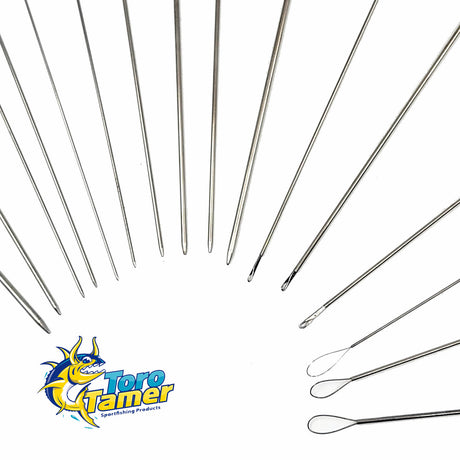
The Handy Latch Needle
Making a spliced end loop is best done with a
small latch needle. The end-loop takes a bit of
practice but once learned it is simple.
Making an invisible line-to-line splice can
be accomplished with the same latch needle used
in the making of the end-loop. It is much easier
to learn. It is 100% sure, nearly invisible and
involves no knot. The line-to-line splice can be
accomplished also with a loop needle or a single
strand wire, so long as the principle of the two
opposing Chinese finger cuffs is not violated.
The line-to-line splice is useful when you
want to:
- add more line to a reel
- replace a damaged portion
- to connect one strength line to another
- to connect a top-shop leader
- to reconnect lines after being cut out of
a tangle
References and Sources:
SPLICING LATCH NEEDLES. This small tool and
detailed instructions and diagrams for making
Spectra to Spectra splices and end loops are
available from your local supplier of Line
One Spectra at a very modest cost.
HOLLOW NEEDLES, LOOP NEEDLES and ACCESSORIES
for making top shots are available from
well-stocked tackle shops or through catalogs.
These kits also contain instructions, waxed
thread, glue and assembly accessories including
a two-clamp device to hold lines while making
half-hitches. (Check the Smitty needles)
METAL SLEEVES with SPECIAL TOOLS and
instructions for making top shots with Line
One Spliceable Spectra are available.
(The Sato Crimp system is the newest and best
product available - listed above)
PRICES
Line One is competitively priced to
Spectra lines of lesser quality.
OTHER PRODUCTS
Jerry Brown Industries also carries
non-hollow Spectra in all usual breaking
strengths.
Protecting Your Hands: Be Careful!!
Like all small diameter lines, Spectra can
cause cuts in your hands or you could risk
cutting a fellow fisherman, so exercise caution.
Never try to break Spectra with your hands.
Cutting Spectra is best done with very sharp
Exacto blades. The cut is clean and it doesn’t
close the hollow braid.
Many fishermen now use a commercially
available self-adhesive material in tape form (Flexx
Wrap), made especially for protecting fingers
when guiding line onto the reel or when
retrieving a fish. Special made gloves are also
available.
Handling
In the early days after the introduction of
Spectra fishing lines, some feared that more
tangles would result because the line was so
flexible, light and small in diameter. These
fears have proven largely unfounded. The fine
sensitivity of these lines allows the fisherman
to "keep in touch" with his bait to keep his
line straight avoiding big loops and
over-lapping lines. The line is opaque and
therefore visible thus helping the fisherman
keep out of troubling situations.
When tangles do occur, be gentle when
separating the lines. The line is not stiff like
monofilament so more finesse is needed. Pulling
the lines tight is likely to tighten the tangle.
Go easy. A little practice is a good teacher.
It’s different, not harder. Remember unlike
monofilament and other Spectra fiber lines,
Line One can be spliced back together in the
event your line is or must be cut for some
reason. These splices are 100% strong.
Some fishermen have avoided using the more
effective short top shots for fear of tangles.
This has been de-bunked along with the mistaken
belief that short top shots combined with low
stretch Spectra jerked you around. The real
cause of this jerking is actually caused by
excessive criss-crossing of the Spectra as it
was spooled on the reel. The rapid removal of
the line peeling off from one-side of the reel
to the other is the real cause. Fishermen using
low stretch Dacron learned this many years ago.
Spectra is a Registered Trademark of
Honeywell